
Asian Games 2026 Kabaddi: India's Schedule, Timings, Broadcast and the Six-Day Arithmetic Nobody Is Reading
**মূল উত্তর:** আসিয়ান Games ২০২৬-এর কাবাড্ডি ইভেন্ট চলবে ২১ সেপ্টেম্বর ২০২৬ থেকে ২৬ সেপ্টেম্বর ২০২৬ পর্যন্ত, জাপানের আইচি শহরের টোকাই সিটিজেন্স জিমনেসিয়ামে। ভারতের ১২ সদস্যের দলের অধিনায়ক কর্নার ডিফেন্ডার সুনীল কুমার; প্রধান Coach বলওয়ান সিং, ডেপুটি Coach বিসি রমেশ। **মূল তথ্য:** - কাবাড্ডি ১৯৯০ বেইজিং আসিয়ান Games থেকে নিয়মিত পদক ইভেন্ট; আইচি-নাগোয়া ২০২৬ আসরটি সংখ্যায় ২০তম। - ভারত ১৯৯০ থেকে ২০১৪ পর্যন্ত টানা সাতটি পুরুষ কাবাড্ডি সোনা জিতেছিল; ২০১৮ জাকার্তার ফাইনালে ইরান সেই ধারা ভাঙে। - ম্যাটে চলবে স্ট্যান্ডার্ড স্টাইল নিয়ম, ৭ বনাম ৭, দুই বিশ মিনিটের অর্ধ; সার্কেল স্টাইল নয়। - প্রধান প্রতিদ্বন্দ্বী ইরান; পরের স্তরে দক্ষিণ কোরিয়া, বাংলাদেশ, পাকিস্তান, চাইনিজ তাইপে ও স্বাগতিক জাপান। - ভারতের ১২ সদস্যের squad-এ বারোটি নাম করা হয়নি; ড্র ও গ্রুপিংও ঘোষিত নয়। **সূত্র:** মূল প্রতিবেদন (Asian Games 2026: India's kabaddi schedule, results, timings, live streaming details), প্রকাশতারিখ উল্লেখ নেই; ভেন্যু ও তারিখ ২১–২৬ সেপ্টেম্বর ২০২৬ হিসেবে উল্লিখিত, যা অলিম্পিক কাউন্সিল অব এশিয়া (OCA) ও ইন্টারন্যাশনাল কাবাড্ডি ফেডারেশনের অফিসিয়াল রিলিজের সঙ্গে যাচাই করা প্রয়োজন। **সম্পর্কিত প্রশ্নোত্তর:** প্রশ্ন: আসিয়ান Games ২০২৬-এ ভারতের কাবাড্ডি ম্যাচের সময় কেন এখনো নির্দিষ্ট নয়? উত্তর: ড্র ও গ্রুপিং ঘোষণা না হওয়ায় ম্যাচের নির্দিষ্ট সময় নির্ধারিত হয়নি, এবং মূল প্রতিবেদনে প্রতিটি তথ্যবিন্দুতে সূত্র উল্লেখ না থাকায় সময় ও সম্প্রচার-তালিকা OCA-র অফিসিয়াল রিলিজ দিয়ে যাচাই করা আবশ্যক। প্রশ্ন: ভারতের টানা সাত সোনার ধারা কীভাবে ভেঙেছিল? উত্তর: ১৯৯০ থেকে ২০১৪ পর্যন্ত সাতটি আসরে ভারত পুরুষ কাবাড্ডি সোনা জেতে, এরপর ২০১৮ জাকার্তার ফাইনালে ইরান ভারতকে হারিয়ে সেই ধারা ভাঙে; হাংঝোতে ভারত ফাইনালে ইরানকে হারিয়ে সোনা পুনরুদ্ধার করে। প্রশ্ন: ছয় দিনের সূচি ভারতের জন্য কেন বড় ঝুঁকি? উত্তর: পাঁচ-ছয় ম্যাচে ডু-অর-ডাইয়ের চাপ তৃতীয় রেইডারের ওপর জমা হয়, আর সীমিত বদলির কারণে অল আউট-সংক্রান্ত একটি ভুল সিদ্ধান্তই স্বল্প সময়ে ম্যাচের মোমেন্টাম উল্টে দিতে পারে।
Six days. September 21, 2026 to September 26, 2026, Tokai Citizens Gymnasium, Aichi, Japan. The entire kabaddi competition of the 20th Asian Games is folded into that window. For three weeks now my notebook has kept returning to one number — six. Who takes gold will be decided by a calendar in which a team may play five or six matches across round-robin and knockout, with the last two rounds potentially falling on consecutive days. I found the beat in the game film before I heard it in the stadium — and here the game film is the schedule. The schedule is India's first opponent, before Iran.
The frame first
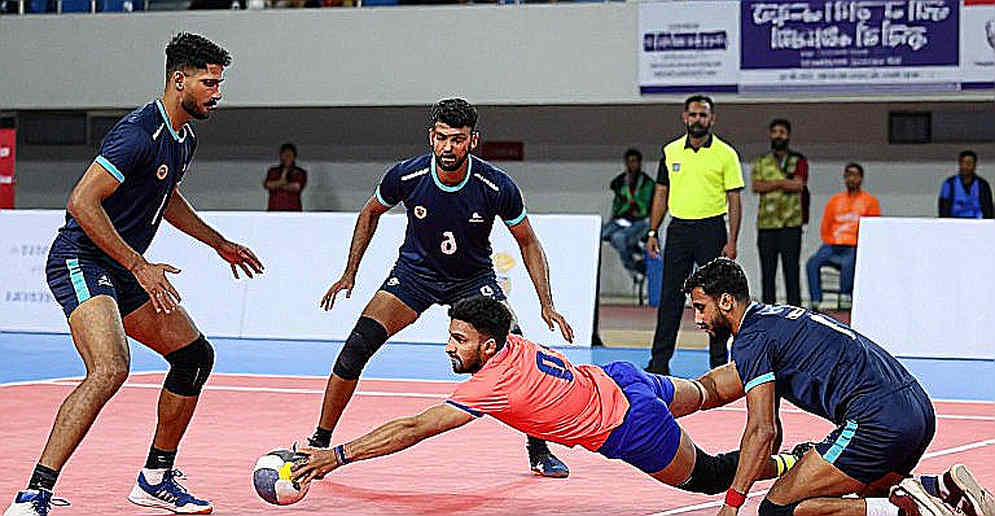
Three lines for readers who have never watched kabaddi. A raider crosses the midline, has 30 seconds to touch an opponent and return to his own half — that is a raid. He must chant 'kabaddi' continuously, with no pause for breath; that chant is the cant, and a broken cant voids the raid. Defenders who collectively stop the raider score a tackle, one point. Deep in the opponent's half runs a marked line, the bonus line; crossing it scores one point when six or more defenders are on the mat. After two consecutive empty raids, the third is do-or-die — no point and the raider himself is out. If every player on one side is out, that is an all out: two bonus points and the whole team revives. The lobby is the side strip; a foot landing outside the boundary also puts the raider out. Those four instruments — 30 seconds, the cant, the bonus line, do-or-die — are the whole arithmetic of kabaddi.
Then the event frame. Kabaddi has been a regular Asian Games medal sport since Beijing 2026, and Aichi-Nagoya 2026 is the 20th edition of the Games. The mat will run Standard Style — the same rulebook as the Pro Kabaddi League, not the rural Circle Style of Punjab. India's 12-man squad has been announced: captain and corner defender Sunil Kumar, head coach Balwan Singh, deputy coach BC Ramesh.
There is a problem here, and it should not be hidden. Nearly every information point in the reports carrying this schedule, timings and live-streaming detail is marked 'Source: None.' There is a 12-man squad but no twelve names. There are coaches but no selection process. There is a venue and a date range but no draw or grouping. So this piece draws a line at the start: what could not be verified will not be dressed up as analysis. Exact match timings and India's broadcast channel list depend on the host broadcaster and the Indian rights-holder; printing that list without an official OCA release would be careless.
The arithmetic inside the mat
In film terms, kabaddi is a game of two clocks — 30 seconds in the raider's hands, and a limited number of do-or-die situations in the team's. A side that spends its first two raids safely is forced to raid at risk on the third, and in a six-day tournament that debt carries the highest interest. A tired raider's dubki — the roll under the tackle — slows by an inch, and an inch is all the corner defender needs.
On India, one contradiction stands out. The promotional language calls this a raid-heavy, attacking side, yet the captain, Sunil Kumar, is a corner defender — the man who pulls the defensive chain from the right corner. A kabaddi team's character is told by where its captain stands. A corner-defender captain means the primary investment sits in defensive synchronisation, and in a six-day frame that is also the sensible investment. Defence travels in short tournaments; raiding does not. The chain — corner, cover, the spacing between defenders — is a pattern, and it holds even under fatigue. When the chain shifts a step earlier, that is the most honest fatigue signal available.
This is exactly where Iran belongs. In the Jakarta 2026 final, Iran beat India and broke a run of seven straight men's golds — 2026 through 2026, seven editions, seven golds. That fact belongs in every India-centric preview, and it is missing from almost all of them. Iran's defence is wrestling-derived: thigh holds, ankle holds, the patience to bring a raider down one on one. They do not frighten raiders into mistakes; they wait. For Indian raiders who live on speed and the dubki, that waiting is infuriating, and mistakes come out of irritation. India regained gold in Hangzhou by beating Iran in the final, but one final does not restore a dynasty — it restores a rivalry.
The bonus line matters more than it looks. With six or more defenders, crossing it earns a point; getting caught while crossing concedes one — net zero, plus the raider is out. For a raider facing do-or-die, that line is both life raft and trap. Those decisions never show in the scoreline; they show on film, in which raid the raider touched the line and in which raid he turned toward the cover. The same logic runs through the super tackle: with three or fewer defenders, a tackle is worth two points, and those two points are what keep the all-out door shut.
There is one more thing the television camera cannot hold. The cant is not only a rule; it is an audio signal. In an enclosed gymnasium with a modest crowd, defenders read the pitch of the raider's voice to judge how much breath he has left and when his rhythm is breaking. The empty stadium gave my notebook a silence it could finally read — I first noticed the principle at Abahani's matches in 2026, in football; in kabaddi the arithmetic is the same, except the sound comes from a human throat rather than a boot.
What is lost without the twelve names should be said plainly. Single-point dependence in a kabaddi side is measured by the distribution of raid points — what share of a team's total raid points the top two raiders carry. Without names and numbers, that calculation cannot exist. Substitutions are limited too; across five or six matches in six days, the load that falls on the third raider is a squad-depth question. So words like depth, experience and leadership blend are not analysis here. They are advertising.
The competitive map, though, is simple. India at the top. Iran immediately below, the side that has already broken the streak once. Then South Korea, many of whose players compete in the Indian league and who know Indian raid patterns from the inside. Bangladesh, Pakistan, Chinese Taipei and hosts Japan sit in the next tier. Host status will lift domestic curiosity in Japan but will not produce a medal threat inside the 2026 cycle. From Sylhet, that stratification is the real story — because Bangladesh's kabaddi survives on the same physical, wrestling-derived defence, a smaller version of Iran's road.
What the outside is misreading
The whole preview industry rests on one sentence: India's gold is near-certain, the only question is Iran. That reading is comfortable, and it points attention at the wrong place.
The risk is not Iran's defence. It is India's own do-or-die accounting. Five or six matches in six days means two or three do-or-die situations per game, and the pressure pools in one place — the third raider. A side that scores in its first two raids uses the third to survive; a side that cannot is forced to take risk, and risk taken badly produces an all out. An all out is not just two points: it is the entire team revived, which means one wrong decision can flip a match's momentum inside three minutes.
Nor does the 'raid-heavy' label fit India's own construction. A corner-defender captain and two experienced coaches describe a control-first team — one that makes the opponent err first and raids second. That is not a weakness; it suits a compressed event. But anybody reading the word 'attacking' and expecting a chaotic, high-risk match will be watching a different game.
The seven-gold story is also a story of a bounded era. 2026 to 2026, then Jakarta 2026 and Iran. Heritage is not current form; when a preview seats heritage where form should sit, expectation inflates, and the inflation deflates after the tournament. India remain favourites — but favourite and certain are one do-or-die apart.
Forward
So what do I watch on September 21? The first ten minutes. Whether India's opening raids are safe or active will say whether the team has understood the six-day arithmetic. Then when the twelve names and the draw arrive; which side of the bracket Iran lands on is the real news, not the timings. And when Sunil Kumar's corner chain shifts one step earlier — that is the fatigue signal, and in a six-day event fatigue is the most honest information on the mat. Nobody knows who takes gold. The calendar, though, is saying one clear thing: the winner will be the side that calculates the third raid best.